
To recap: Pilot Profiles are archetypes I created to understand how Magic: The Gathering players pilot the decks we build. We assess these archetypes based on two criteria: threat assessment and card selection. These criteria were defined using questions that allowed us to categorize a player’s actions. In this post, I want to further refine the criteria I established. Below are the questions I used to establish the criteria:
How aggressive is your threat assessment?
This question aims to understand not the quality of a player’s threat assessment, which is more closely tied to their experience with that skill, but rather how a player responds to threats. Are players proactive in their threat assessment, targeting certain decks, commanders, and playstyles, or are they reactive, targeting only problematic permanents, varying how quickly they respond?
How flexible are your card choices?
This question aims to understand whether you pick more synergistic or functional cards. This is not a question necessarily about the cards themselves, although that certainly plays a factor, but more about what the pilot prioritizes.
From these questions, I identified the following four profiles:
Assassin: a pilot who player with targeted threat assessment and chooses cards to prioritize specific functions.
Opportunist: a pilot with passive threat assessment and makes card choices to achieve specific functions.
Snowballer: a pilot with targeted threat assessment and makes card choices that cover a wide variety of functions.
Field General: a pilot with passive threat assessment and makes card choices that cover a wide variety of functions.

However, I found that these definitions were lackluster in that while they were established using the criteria, failed to adequately differentiate from each other when I assembled them like I did above. So, as I wrote about the criteria, I started with definitions that made more sense to the archetypes. In short, the last go around I established criteria and created archetypes from them. This time, I am starting with archetype definitions and refining the base criteria used to establish them.
Let’s start with the new archetype definitions.
Assassin: a pilot who identifies which players pose the biggest potential threats and prioritizes cards that help them remove players from the game.
Opportunist: a pilot that prioritizes cards in order to build an engine or combo and answers threats that prevent them from doing so.
Snowballer: a pilot that prioritizes cards to amass resources as efficiently as possible and answers threats that prevent them from doing so.
Field General: a pilot that assesses threats on the board and prioritizes cards that answer multiple threats as efficiently as possible.
Were you able to spot the differences between these definitions and the previous ones? We were more specific about our descriptions of how each archetype accomplishes their criteria, which in turn allows us to develop new definitions for our criteria.
Threat Assessment is the ability of a pilot to identify threats among players, permanent types, deck themes, and board states.
Card Selection is the ability of a pilot to correctly prioritize cards to achieve specific effects, whether in the deckbuilding process or during the game.
What I think is helpful about this update is that it not only covers a wider range of potential game behaviors, but each definition for both archetypes and criteria alike are more easy to understand.
I’ll be posting over the next few weeks about the strengths and weaknesses of these different pilot archetypes and what you can do to improve your approach if you fit one more than the others. See you then!
Bonus Card Review
In a past Friday Card Review, I mentioned that I was generally unimpressed with the Avatar set. After all, they made a card for Hei Bai but not for Koh the Face Stealer? Something isn’t right. Perhaps they will come out with a card for it, but at the time of writing this I doubt it. That said, there was a single exception:
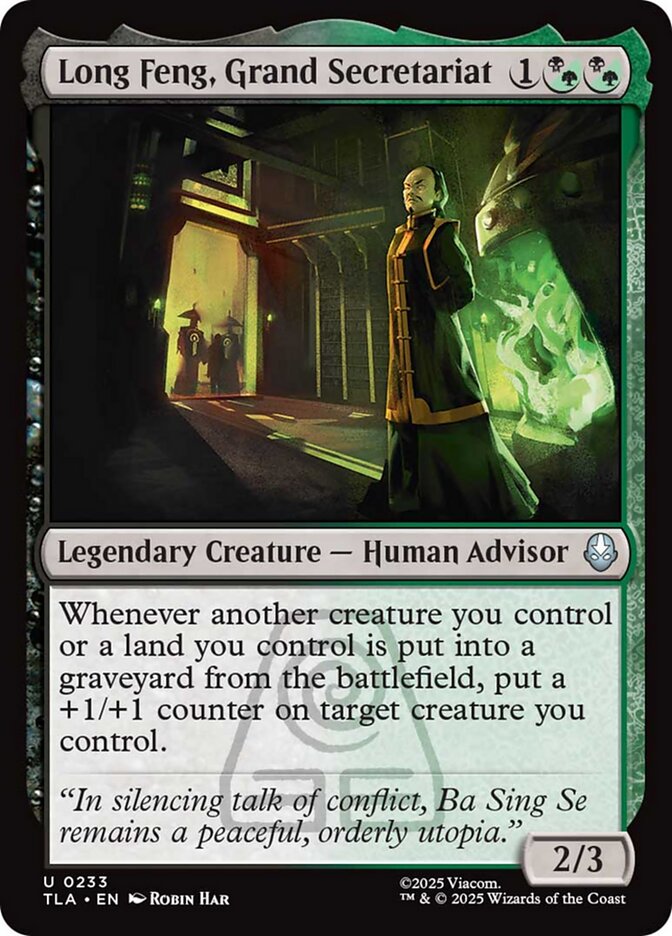
The strategy I think best fits Long Feng is a land animation - aristocrats deck that is constantly creating and sacrificing land creatures in order to make other land creatures bigger. Both Green and Black care about the power of creatures when they die, so this feels like a perfect way to bridge the two colors into a deck that never really runs out of creatures to sacrifice.